How much mobile data do you need in Japan for 3, 5, 7, 10 or 14 days?
For a week in Japan, a light user (maps, messages, translation) needs about 1.2 GB, a typical user who also posts photos and scrolls social media needs about 4 GB, and a heavy user who streams video or runs a hotspot needs about 12 GB. For 3 days those numbers are roughly 0.5, 1.7 and 5 GB; for 14 days roughly 2.5, 8 and 24 GB. All figures include a 15% safety margin.
These are the same numbers our homepage plan finder uses. Below is how we get them, the full list by trip length, and the plan each one points to.
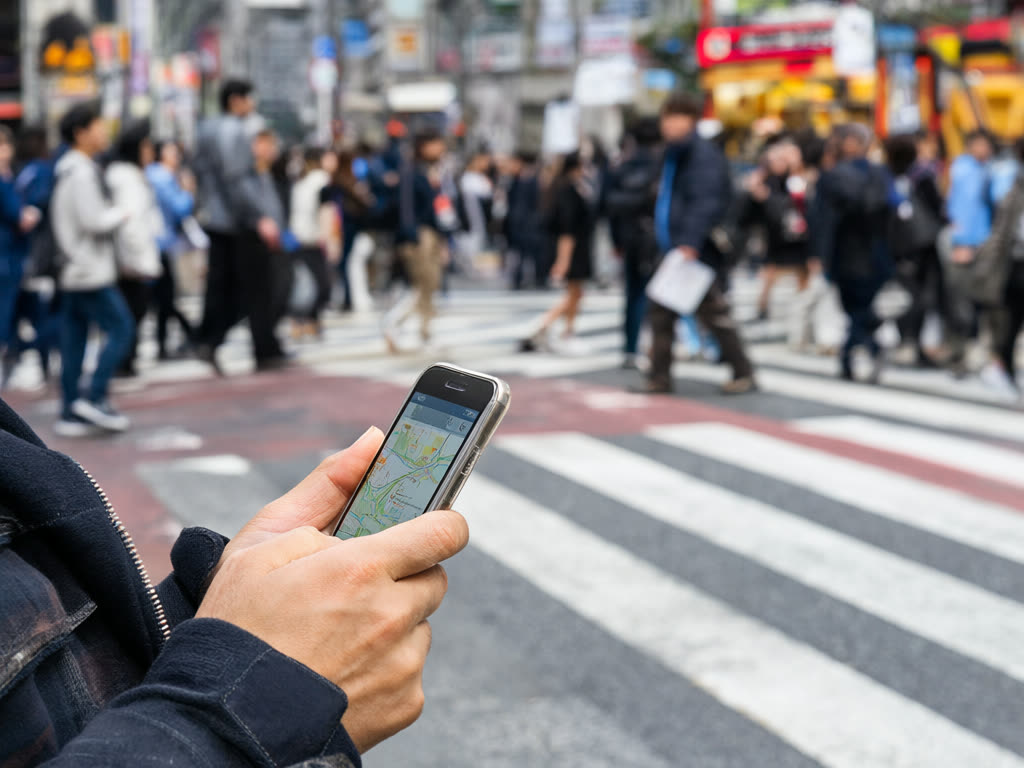
The usage model behind the numbers
We estimate daily use in three profiles and then add 15% so the last day is not a scramble.
- Light, about 150 MB a day. Navigation, route searches for trains, messaging apps, camera translation for menus, and the occasional photo sent to family.
- Typical, about 500 MB a day. Everything above plus social media scrolling, posting photos and short clips, and the odd video call.
- Heavy, about 1.5 GB a day. Everything above plus streaming video, long video calls, uploading lots of video, or sharing your connection with a laptop.
We count 1 GB as 1,000 MB, which is how mobile data is normally measured. The margin covers background activity you do not notice, such as app updates that start while you are out or a photo library that syncs without asking.
Data needed by trip length
Each line gives the total for the whole trip, with the margin included, and the smallest of our plans that covers it.
3 days
- Light: about 0.5 GB, so 1GB / 7 days (¥480)
- Typical: about 1.7 GB, so 3GB / 15 days (¥780)
- Heavy: about 5.2 GB, so 10GB / 30 days (¥1,780)
5 days
- Light: about 0.9 GB, so 1GB / 7 days (¥480), with little room to spare
- Typical: about 2.9 GB, so 3GB / 15 days (¥780), also close to the limit
- Heavy: about 8.6 GB, so 10GB / 30 days (¥1,780)
7 days
- Light: about 1.2 GB, so 3GB / 15 days (¥780)
- Typical: about 4 GB, so 5GB / 30 days (¥1,100)
- Heavy: about 12 GB, so 20GB / 30 days (¥2,880)
10 days
- Light: about 1.7 GB, so 3GB / 15 days (¥780)
- Typical: about 5.8 GB, so 10GB / 30 days (¥1,780)
- Heavy: about 17 GB, so 20GB / 30 days (¥2,880)
14 days
- Light: about 2.4 GB, so 3GB / 15 days (¥780)
- Typical: about 8 GB, so 10GB / 30 days (¥1,780)
- Heavy: about 24 GB, so 50GB / 30 days (¥5,480), or 20GB if you push video uploads onto hotel Wi-Fi
The plan length matters as well as the data. A 7-day plan cannot cover a 10-day trip even if the data would last, which is why the 1GB plan drops out after a week.
Why the homepage finder sometimes suggests one size up
The finder asks for a range of days (1 to 3, 4 to 7, 8 to 15, 16 to 30) rather than an exact number, and it calculates for the top of that range. A 5-day trip is treated as 7 days, so a typical user is pointed to 5GB rather than 3GB. That is deliberate: being a little over is cheaper than running out. If you know your exact dates and your habits, the lists above let you fine-tune. If a plan shows "Restocking soon", the finder offers the closest plan that is in stock.
What actually uses the data
Rough hourly figures, so you can sanity-check your own profile:
- Maps and navigation: around 15 MB an hour. A full day of walking with maps open rarely passes 100 MB.
- Social media with images and short videos: around 150 MB an hour.
- Video calls: around 500 MB an hour.
- Standard-definition video streaming: around 700 MB an hour.
- HD video streaming: around 2 GB an hour.
So 1 GB is about 65 hours of maps but only about 6 hours of social scrolling or one to two hours of video. Most people underestimate video and overestimate everything else.
When these numbers do not apply
- You share your connection. Hotspot is allowed on our plans, but every connected device uses the same allowance. A laptop can burn through a gigabyte in an hour of updates and cloud syncing. Treat hotspot use as heavy, and see using an eSIM as a hotspot.
- You work remotely from your phone. Video meetings and file uploads put you firmly in the heavy profile.
- You rarely see Wi-Fi. If you stay in places without reliable Wi-Fi, such as some rural inns, shift up one profile.
- Your trip is longer than 30 days. Each plan lasts up to 30 days. Buy a second eSIM before the first one ends.
Common mistakes
- Reading a plan as a daily amount. A 5GB plan is 5 GB for the whole trip, not per day.
- Forgetting automatic uploads. Turn off cloud photo backup over mobile data, and set app updates to Wi-Fi only.
- Buying for the trip you wish you were having. If you post video every evening, you are a heavy user even if you only plan to "check maps".
- Not checking the plan length. Match the days first, then the data.
If you do run out, you can buy another plan, which arrives as a new eSIM to install. Our page on what to do when your data runs out covers the details.
Quick answer: plan on about 150 MB a day for light use, 500 MB for typical use and 1.5 GB for heavy use, plus 15%. For most one-week trips that means 3GB (light) or 5GB (typical); for two weeks, 3GB (light) or 10GB (typical). Heavy users should look at 20GB or more.
For setup, compatibility and our rules, see the Japan eSIM guide. If you are still deciding between an eSIM and a rental router, read eSIM vs pocket Wi-Fi vs SIM card.
Last updated: 18 October 2026.
Know your number? Pick the plan that covers it
Every plan is a total amount of data for the whole trip, and the days only start when the eSIM first connects in Japan. Our plan finder on the homepage does this maths for you.
Japan eSIM from ¥480